
 Español
 English
 Deutsch
 Français
 Italiano
 Português
 Nederlands
 Suomi
Suomi Dansk
Dansk Norsk
Norsk Svenska
 Polski
 Čeština
 Slovenčina
 Magyar
 Slovenščina
 Български
 Hrvatski
 Österreich
 België
History of Oranges
The Persian orange, widely cultivated in southern Europe after its introduction to Italy in the 11th century, was bitter. The sweet orange was brought in the 15th century from India by Portuguese traders; it quickly replaced the bitter one, and today it is the most commonly cultivated variety. The sweet orange grows to different sizes depending on local conditions, commonly with ten segments inside.
Portuguese, Spanish, Arab and Dutch sailors planted citrus trees along the trade routes to prevent scurvy. On his second voyage in 1493, Christopher Columbus brought orange and lemon seeds to Haiti and the Caribbean. They were introduced into Florida, together with lemons, in the year 1513 by the Spanish explorer Juan Ponce de León; in California it was introduced by the Franciscans along El Camino Real of California in the second half of the 18th century, and in Hawaii in 1792.
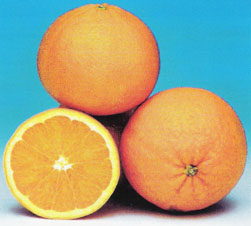
Navel Orange
A singular mutation in 1820 in a grove of sweet oranges planted at a monastery in Brazil led to the navel orange, also known as the "de orilla" or the navel of Bahia. The mutation causes the navel orange to develop a second orange at the base of the original. In commercial terms, the English translation of the term "ombligo" (navel) is used, from which several varieties have been derived, such as the navelina, a hybrid with an easy-to-peel rind, and the navelate, which would be the late navel, since "late", in English, means tardy, later.
Valencia Orange
The Valencia orange is one of the sweet varieties used for juice extraction, as its season comes after other oranges; it is popularly consumed once the season of the navel oranges has passed. The popular term is Valencia Late
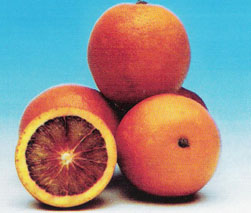
Blood Orange
The blood orange has red streaks on the skin, and the juice is often a dark Burgundy colour. The fruit has carved out a place as an interesting variation of ingredient over the traditional Seville marmalade, with its red streaks and its distinct flavour. The scarlet navel is a variety with the same diploid mutation as the navel orange.